

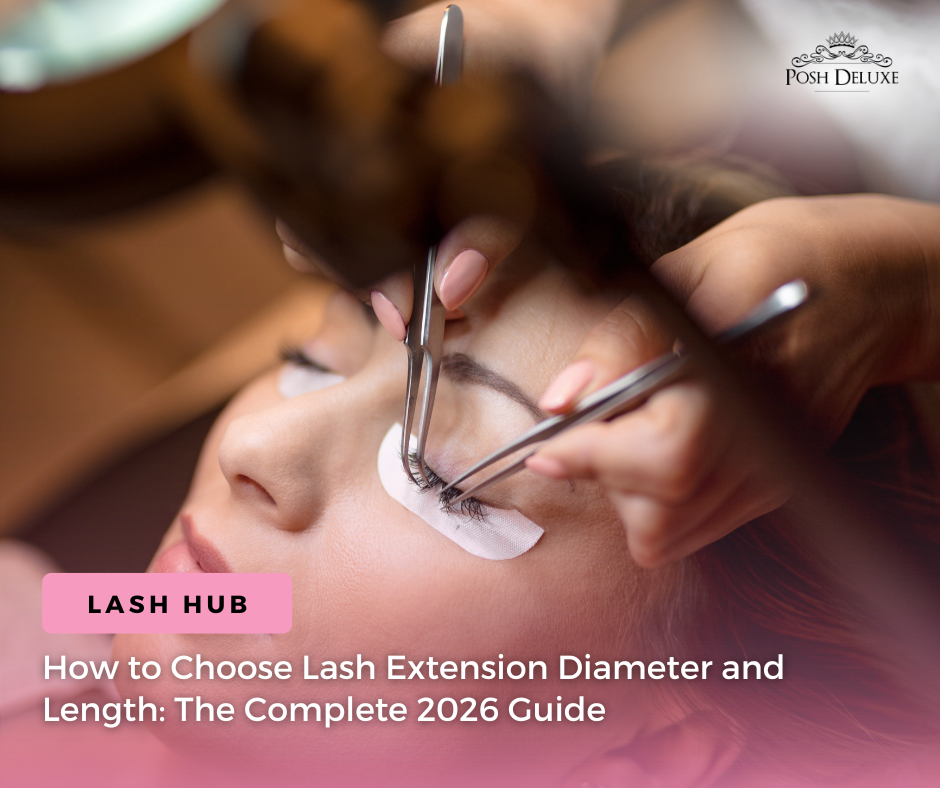
Lash extension diameter and length are the two most underestimated decisions in every lash appointment. Get them right and your set feels weightless, looks beautifully proportioned, and lasts the full natural lash cycle. Get them wrong and your extensions feel heavy, damage your natural lashes over time, and drop off in weeks — no matter how skilled the artist.
This guide covers every diameter and every length available in the professional Australian market in 2026, how to match each to natural lash strength and eye shape, and how to build a complete lash-style kit that works across all your clients.
What Diameter Means (And Why It Matters)
Lash extension diameter is the thickness of the extension, measured in millimetres. A 0.03 mm lash is ultra-fine — thinner than a strand of human hair. A 0.20 mm lash is thick, heavy, and closer to a strip lash fibre. Every 0.02 mm increase in diameter roughly doubles the weight the natural lash is asked to carry.
The absolute rule of lash extensions: an extension should never weigh more than the natural lash it's bonded to. Applying a heavy extension to a fine natural lash causes damage — the natural lash bends under the weight, sheds prematurely, and can permanently thin over months of wear.
Every Diameter Explained

-
0.03 mm — Mega Volume Ultra-Fine
- The finest diameter in professional use. Perfect for building fans of 10, 12 or 14 lashes per natural lash without exceeding the safe weight. Feels weightless on the eye and gives the fluffiest possible mega volume look. Not suitable for classic technique — too fine to place individually.
- Shop the 0.03 mm range: 0.03 10D Rapid Promade Fans, 0.03 12D Rapid Promade Fans, plus DD volume trays in Champion Black Lashes.
- The finest diameter in professional use. Perfect for building fans of 10, 12 or 14 lashes per natural lash without exceeding the safe weight. Feels weightless on the eye and gives the fluffiest possible mega volume look. Not suitable for classic technique — too fine to place individually.
-
0.05 mm — The Volume Workhorse
- The most-used diameter in professional volume application worldwide. Fine enough to build fans of 3–8 lashes safely, thick enough to give visible volume. If a lash artist could only stock one diameter, most would choose 0.05.
- Shop 0.05 volume options: Volume lash range, Champion Volume Lashes in all curls, and promade fans including 0.05 8D.
- The most-used diameter in professional volume application worldwide. Fine enough to build fans of 3–8 lashes safely, thick enough to give visible volume. If a lash artist could only stock one diameter, most would choose 0.05.
-
0.06 mm — The Balanced Volume
- Between 0.05 and 0.07 — slightly more visible than 0.05, gentler than 0.07. Good choice for volume fans of 2–5 lashes on medium-strength natural lashes. A popular hybrid-set diameter.
-
0.07 mm — The Bold Volume / Hybrid Standard
- The default diameter for hybrid sets and lighter volume looks. Delivers visible fullness with fans of 2–4 lashes. Also used in mega hybrid work when the client has strong natural lashes and wants pronounced texture.
-
0.10 mm — The Classic Standard
- The default diameter for classic (1:1) lash extensions. Delivers the mascara-like natural look most classic clients expect. Applied one extension per one natural lash — never used in fan form, as the weight of two 0.10 lashes on one natural lash exceeds safe limits.
- Shop 0.10 classic options: Champion Classic Lashes in every curl (available in 0.10 across the range).
- The default diameter for classic (1:1) lash extensions. Delivers the mascara-like natural look most classic clients expect. Applied one extension per one natural lash — never used in fan form, as the weight of two 0.10 lashes on one natural lash exceeds safe limits.
-
0.15 mm — The Heavy Classic
- A thicker classic diameter delivering more dramatic mascara-like results. Only safe on clients with genuinely strong, thick natural lashes. Overapplied on delicate natural lashes, 0.15 causes visible damage within 2–3 sets.
-
0.18 mm and 0.20 mm — The Warning Zone
- These diameters exist in the market but are rarely recommended by educated lash artists. The extension weight approaches the weight of the natural lash itself, and long-term retention damage is almost inevitable. Most Australian professional educators do not recommend these diameters at all.
- These diameters exist in the market but are rarely recommended by educated lash artists. The extension weight approaches the weight of the natural lash itself, and long-term retention damage is almost inevitable. Most Australian professional educators do not recommend these diameters at all.
Matching Diameter to Natural Lash Strength
The single most important rule in diameter selection: assess your client's natural lash strength before choosing. A skilled lash artist runs a fingertip along the natural lash line before every appointment to feel the natural lash density and diameter.
- Fine, sparse natural lashes: 0.03 or 0.05 only. Never thicker.
- Medium natural lashes (most clients): 0.05, 0.06 or 0.07 for volume; 0.10 for classic.
- Strong, thick natural lashes: Any diameter up to 0.10; 0.15 for dramatic classic looks only.
- Damaged or recovering natural lashes: 0.03 only, or a break from extensions altogether to allow regrowth.
What Length Means (And Why It Matters)
Lash extension length is the length of the extension from base to tip, measured in millimetres — typically 7 mm at the shortest to 16 mm at the longest for professional use.
The rule for length: an extension should never be more than 3 mm longer than the natural lash it's bonded to. Longer than that and the weight distribution becomes unstable, causing the extension to twist, droop, or shed prematurely. A well-chosen length looks proportionate to the eye and doesn't reach past the natural brow line.
Every Length Explained
- 7–8 mm — The shortest lengths. Used at the inner corners of the eye where natural lashes are shortest. Rarely used across the whole set.
- 9–10 mm — Standard mid-length. The middle third of most lash sets uses lengths in this range for balanced proportion.
- 11–12 mm — Longer lengths for the outer third of the eye. Creates a lifted, cat-eye effect when placed at the outer corner.
- 13–14 mm — Long lengths for dramatic styling. Used for editorial, competition, and bold everyday looks on clients with strong natural lashes.
- 15–16 mm — Extra-long. Used only on clients with exceptional natural lash length and strength. High risk of natural lash damage if misapplied.
For a deep dive on the shortest lengths and inner-corner styling: What Are the Shortest Lash Extensions?.
Matching Length to Eye Shape
- Almond eyes: Standard proportion — shorter at inner corner (7–9 mm), medium mid-lash (10–11 mm), longer outer (12–13 mm).
- Round eyes: Emphasise outer corners — shorter inner (8 mm), medium (10 mm), significantly longer outer (13 mm+).
- Downturned eyes: Strong outer lift — longer at outer corner (13–14 mm) with D curl.
- Hooded eyes: Avoid extreme long lengths on the middle of the lash line — they get lost under the lid. Longer at outer corner only.
- Deep-set eyes: Uniform medium-length lengths (9–11 mm) with D or DD curl to bring the lashes forward visually.
- Wide-set eyes: Emphasise inner third with slightly longer lengths (10–11 mm) to visually pull the eyes closer together.
- Close-set eyes: Opposite — emphasise outer corners with longer lengths (12–13 mm) to visually widen.
Mixed-Length Trays vs Single-Length Trays
Professional lash trays come in two formats:
- Mixed-length trays: Contain multiple lengths across the tray (typically 7 mm through 12 mm or 13 mm through 16 mm in one tray). Efficient for lash mapping — you pick the length you need for each position without swapping trays.
- Single-length trays: Contain only one length. Useful when you need bulk quantities of a specific length (e.g. large classic sets using primarily 11 mm).
Most working artists stock a mix of both — single-length in the workhorse mid-range (10–12 mm) and mixed-length for the shorter and longer end-points.
Shop the full range: Champion Black Lashes collection — every curl, every diameter, every length, mixed and single-length trays.
Building a Complete Lash Extension Kit
A well-stocked working lash artist's kit typically includes:
- Classic 0.10 mm in C and CC (and often D) across lengths 8–14 mm.
- Volume 0.05 mm and 0.07 mm in C, CC and D across lengths 8–14 mm.
- Mega volume 0.03 mm in CC, D and DD across lengths 9–14 mm.
- L and M curls in 0.07 for hooded-eye clients (both classic and volume).
- A range of promade fans (3D through 12D) for speed.
Start smaller as a new artist — one classic diameter, one volume diameter, three curls (C, CC, D), and mixed-length trays. Expand as your client base grows.
Read more: How to Start a Lash Business in Australia, and Wholesale Lash Supplies Australia.
Common Diameter and Length Mistakes
- Applying 0.07 volume fans to fine natural lashes. The fan weight exceeds what the natural lash can carry. Damage becomes visible over 2–3 sets.
- Using 0.10 classic on delicate natural lashes. Same problem — the extension is too heavy relative to the base lash.
- Choosing lengths based on client preference alone. The client wants 14 mm; her natural lashes are 6 mm. That's a 3+ mm mismatch and guaranteed retention failure.
- Uniform length across the whole lash line. Real lashes vary in length. Uniform extension length looks unnatural and unbalanced.
- Stocking too many diameters as a new artist. Master 0.05 and 0.10 before expanding. Diameter chaos hurts consistency.
- Overloading the outer corner. Very long outer-corner lashes can droop and drag the lash line down over time.
Frequently Asked Questions
What's the difference between 0.05 and 0.07 lash extensions?
0.05 mm is a finer diameter used for softer volume fans of 3–8 lashes. 0.07 mm is slightly thicker and used for hybrid sets or lighter volume fans of 2–4 lashes. 0.05 gives a softer look; 0.07 gives a more visible fullness.
What diameter is best for mega volume lashes?
0.03 mm is the standard for mega volume — fine enough to build fans of 10, 12 or 14 lashes without exceeding safe weight on the natural lash.
What length should my lash extensions be?
Between 2 and 3 mm longer than your natural lashes for most positions, with shorter at the inner corner and longer at the outer corner. Your lash artist will assess this during consultation.
Are 0.15 or 0.20 mm lashes safe?
0.15 mm is safe only on clients with genuinely strong, thick natural lashes and should not be used in fan form. 0.18 and 0.20 mm are not recommended by educated lash artists — the weight approaches or exceeds the natural lash weight and causes damage over time.
How do I know how long my natural lashes are?
Your lash artist measures during consultation. As a rough guide: natural lashes typically range from 5 to 12 mm depending on genetics. Most clients' natural lashes are around 7–9 mm at their longest.
Can I get 14 mm lash extensions?
Only if your natural lashes are at least 11 mm at their longest point. Otherwise, the weight distribution makes retention very poor and can damage your natural lashes.
What's the most popular length for bridal lashes?
Most bridal sets peak at 12–13 mm at the outer third of the eye, with 9–11 mm through the middle. Photographs beautifully without looking overdone.
The Bottom Line
Diameter and length are where the technical craft of lash extensions really lives. The right choices deliver sets that feel weightless, look proportioned, and protect the natural lash. The wrong choices produce heavy, uncomfortable, quickly-shedding sets that damage the natural lash over months. Match diameter to natural lash strength, match length to eye shape and natural lash length, and vary both across the lash line for a natural, flattering result. Browse the complete Posh Deluxe Champion Lashes range — every diameter, every length, every curl. For the companion pieces on choosing style and curl: see our complete lash curl guide and the Classic vs Hybrid vs Volume vs Mega comparison in the Lash Hub.


