

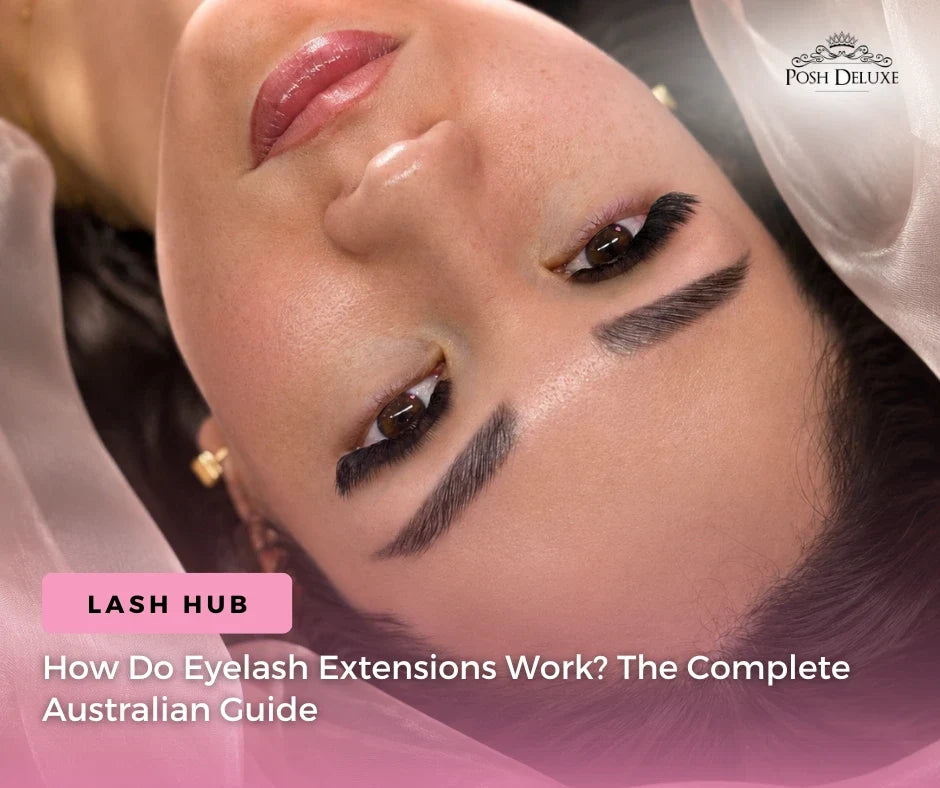
"How do eyelash extensions actually work?" is the underrated question everyone thinking about lashes asks — and the one most beauty content answers with a two-sentence non-answer. The mechanics of lash extensions are genuinely interesting, involve real chemistry and biology, and understanding them properly helps you decide whether extensions are right for you and what to expect if you book.
This guide walks through exactly how lash extensions work — from the natural lash biology they rely on, through the bonding chemistry that holds them in place, to the shed cycle that eventually removes them. Written for anyone curious about the science behind the look, and for first-time clients wanting to know what to expect at their appointment.
The Short Answer
Eyelash extensions are individual synthetic lashes (or small fans of multiple lashes) that are bonded one at a time to your natural lashes using a specialised cyanoacrylate adhesive. Each extension is placed on a separate natural lash, close to (but not touching) the eyelid skin. The extensions stay attached until the natural lash they're bonded to sheds naturally — typically 4–6 weeks later.
Extensions are not applied to your skin, not glued to your eyelid, and not attached to the lash line as a strip. Each extension is bonded to one single natural lash hair, chosen and isolated by the lash artist. When done properly, they look identical to natural lashes because they are attached to natural lashes.
The Biology — How Your Natural Lashes Actually Work
To understand how extensions work, you need to understand a bit about how your natural lashes work.
Each of your natural lashes has a life cycle of approximately 60–90 days, divided into four phases:
- Anagen (growth phase): the lash is actively growing longer. About 30–40% of your lashes are in this phase at any moment.
- Catagen (transition phase): growth slows and stops. Lasts about 2–3 weeks.
- Telogen (resting phase): the lash is fully grown, stable, and just sitting there. This is where most lashes spend most of their life.
- Exogen (shedding phase): the lash falls out naturally as a new lash begins forming underneath.
You have about 90–150 natural lashes per eye at any given time, all cycling through these phases at different rates. On any normal day, you shed between 1 and 5 natural lashes per eye — this is completely normal and happens whether you have extensions or not.
Why this matters for extensions: when you get lash extensions, the extension is bonded to a specific natural lash. When that natural lash sheds (which it will, on its own natural schedule), the extension goes with it. This is why extensions eventually fall out — it's the natural lash cycle at work, not the extension itself failing.
The Chemistry — How the Adhesive Actually Bonds
The magic of lash extension application is the adhesive — specifically a chemical called cyanoacrylate. This is the same chemistry family as household super glue, but professional lash adhesive is heavily refined and stabilised for use near the eye.
How cyanoacrylate cures
Cyanoacrylate is a liquid at room temperature that reacts with moisture in the air (or on surfaces) to instantly polymerise — a chemical process where molecules link together to form a hard, stable plastic-like bond. When lash adhesive touches the natural lash and the extension simultaneously, moisture in the air triggers polymerisation within 1–2 seconds, forming a strong bond that lasts weeks.
Why humidity matters so much
Because cyanoacrylate cures using airborne moisture, the humidity of the room where the lashes are applied dramatically affects the outcome. Too little humidity (below 40%) and the adhesive cures slowly and unevenly. Too much (above 60%) and it shock-cures — hardening so fast it becomes brittle. Professional lash artists in Australia often use humidity meters to check studio conditions before selecting the right adhesive for the day.
Why the extension doesn't touch your skin
Each extension is placed 0.3–0.5 mm from the eyelid skin — on the natural lash itself, not touching the skin. If adhesive touches skin, it can cause irritation and — for a small number of sensitised clients — an allergic reaction. Proper placement is one of the most important technical skills in lash extension application.
The Application Process — Step by Step
Step 1: Consultation (5–15 minutes)
Your lash artist assesses your natural lashes and discusses what style, curl, length, and diameter will suit you best. This is when you share any allergies, contact lens use, sensitivity issues, or previous lash appointment experiences. A skilled artist takes the consultation seriously — it's where the right decisions get made.
Step 2: Preparation (10 minutes)
You lie flat on a comfortable lash bed. Soft gel eye pads are placed under your eyes to hold your lower lashes safely out of the way. Your upper lashes are cleansed with an oil-free lash cleanser to remove any makeup, sebum or residue, then primed with a solution that balances the pH of the natural lash for optimal bonding.
Step 3: Isolation (throughout)
Your lash artist uses two tweezers throughout the appointment — one to isolate a single natural lash from the others, one to pick up and place the extension. Isolation is the single most important technique skill because if two natural lashes are bonded together with an extension (a "stickie"), when one sheds it drags the others with it — causing premature shedding and potentially damaging the natural lashes.
Step 4: Application (1.5–3.5 hours total)
One extension at a time, your artist picks up a lash from the tray, dips the base into a small drop of adhesive, and places it onto the isolated natural lash. For classic sets, one extension per one natural lash. For volume sets, a fan of 2–14 fine extensions is created and placed onto each natural lash — the fan spreads out to give the volume look.
You'll hear soft clicking sounds from the tweezers, feel gentle pressure near your lash line, and possibly notice a slight cool sensation from the adhesive drying. Your eyes stay gently closed the entire time.
Step 5: Cure and Finish (5 minutes)
Once all extensions are placed, your lash artist uses a fine bonder or superbonder solution to fully cure the adhesive across the set — locking every bond into its final strength. This step massively improves retention. You then have the eye pads removed and can look at the finished result.
Want the client-side detail? Read our companion guide: First Time Getting Lash Extensions — The Complete Beginner's Guide.
What Happens After the Appointment
The first 24 hours are the critical curing window:
- The adhesive needs 24 hours to reach full strength.
- No water, no steam, no makeup, no rubbing during this window.
- After 24 hours, normal (adjusted) routine resumes.
From day 2 onwards, your extensions look and behave exactly like enhanced natural lashes:
- They flex with your natural lashes as your eyes blink and move.
- They shed with your natural lashes on the normal 60–90 day cycle.
- They don't fall off suddenly — they gradually shed one by one, mirroring the natural lash cycle.
- They need daily washing and a slightly adjusted skincare routine to last their full potential (see our aftercare guides).
How Long Extensions Actually Last
Full retention of an eyelash extension set typically lasts 4–6 weeks. The exact duration depends on six factors: application quality (the artist's technique), product quality (the adhesive), your natural lash cycle, your aftercare routine, your lifestyle, and your climate exposure.
Most Australian clients book infill appointments every 2–3 weeks in summer (faster shedding cycle) and 3–4 weeks in winter (slower cycle). An infill just tops up the extensions that have shed since the last visit — much cheaper and faster than a full new set.
Read more: How Long Do Lash Extensions Last? The Complete Guide, and 15 Common Lash Retention Killers.
Do Extensions Damage Natural Lashes?
This is one of the biggest myths in beauty. When properly applied by a trained lash artist, extensions do not damage your natural lashes. Damage happens from three specific things:
- Extensions that are too heavy for the natural lash. If a lash artist uses too thick a diameter or too long an extension, the weight bends the natural lash and can permanently thin it over months.
- Sticky bases (stickies). Where multiple natural lashes are bonded together by one extension — when one sheds it rips the others out too.
- DIY removal at home. Trying to pull extensions off with tweezers, oil, or picking at them tears out natural lashes with them.
None of these are inherent to extensions — they're consequences of poor application or bad aftercare. See DIY Removal Disasters for the removal-side detail.
The Different Extension Styles Explained
- Classic: one extension per natural lash. Mascara-like natural enhancement.
- Hybrid: 70% classic + 30% volume fans. The wispy/foxy look trending in 2026.
- Volume: fans of 2–6 ultra-fine extensions per natural lash. Fluffy, full effect.
- Mega Volume: fans of 8–14 ultra-fine extensions per natural lash. Full drama.
- Wet Lash Effect: a styling technique with spiky clusters and visible gaps — the 2026 trend. See our Wet Lash Effect Guide.
- Coloured Lashes: accents in browns, blues, pinks, gold and more. See our Coloured Lash Extensions Guide.
Extensions vs Alternatives — Quick Compare
- Extensions add lashes; lash lift just curls what you have.
- Extensions last 4–6 weeks; strip lashes are single-use, lash serums grow your own over 8–12 weeks.
- Extensions are professional-application only; magnetic lashes and strip lashes are at-home DIY.
For the full extension vs lift comparison, see Lash Extensions vs Lash Lift.
Frequently Asked Questions
How do eyelash extensions work?
Eyelash extensions are individual synthetic lashes bonded to your natural lashes using a cyanoacrylate adhesive. Each extension is placed on one natural lash, 0.3–0.5 mm from the eyelid skin. The extension stays attached until the natural lash sheds naturally on its own 60–90 day cycle.
Do eyelash extensions damage your natural lashes?
Not when applied correctly by a trained artist. Damage happens from wrong-diameter extensions (too heavy), sticky bases (multiple lashes bonded together), or DIY removal at home. Professional application on healthy natural lashes causes no damage.
How long does it take to apply eyelash extensions?
A full set takes 1.5–2 hours for classic, 2–2.5 hours for hybrid, 2–3 hours for volume, and 2.5–3.5 hours for mega volume. Infill appointments (every 2–4 weeks) take 45–90 minutes depending on how many extensions have shed.
Does it hurt to get eyelash extensions?
No. Application is completely painless. You feel gentle pressure near your lash line and possibly a cool sensation from the adhesive drying. If you feel any actual discomfort, tell your artist immediately — that's a sign of skin contact or another issue.
Can you sleep with eyelash extensions?
Yes. Back-sleeping is best for retention; side-sleeping is fine (especially on a silk pillowcase). Face-down sleeping crushes the lashes and cuts retention by up to 40%. Read our full guide on sleeping with lash extensions for detail.
Are eyelash extensions safe?
Yes, for most clients. About 1–2% of clients experience an allergic reaction to lash adhesive (usually cyanoacrylate or carbon black). Symptoms appear 24–72 hours after application. Always tell your artist about any known allergies. See our full allergy guide for detail.
How do lash extensions come off?
They shed naturally with your own natural lash cycle. Extensions fall off one at a time as the natural lash they're bonded to reaches the end of its 60–90 day life cycle. Never try to remove extensions at home — book a professional removal ($30–$50, 20 minutes).
What is the adhesive made of?
Professional lash adhesive is cyanoacrylate-based, the same chemistry family as household super glue but heavily refined for safe use near the eye. Cyanoacrylate cures via reaction with airborne moisture, forming a hard polymer bond within 1–2 seconds.
Why do my extensions fall out earlier than my friend's?
Six factors: application quality, product choice, your natural lash cycle, aftercare routine, lifestyle, and climate exposure. Even the same artist on the same day can produce different retention on two different clients because so many factors are individual.
The Bottom Line
Eyelash extensions work by bonding individual synthetic lashes to your natural lashes using cyanoacrylate adhesive that cures in seconds via airborne moisture. They stay attached until your natural lash cycle sheds them 4–6 weeks later. When professionally applied by a trained lash artist using quality products, they cause no damage — they simply enhance your natural lashes for the length of the natural lash cycle. Browse the full Posh Deluxe lash range for the products behind every professional set, book at Posh Deluxe Salon if you're in Perth, or get in touch if you have specific questions before booking your first set.


